 Kilimanjaro Climbing Tours
7 Day Rongai Route: Kilimanjaro From the Quiet North Side
This 7 day Rongai route climb runs from Moshi up the quiet north side of Kilimanjaro and comes down the Marangu Route. Jaynevy Tours sells it on GetYourGuide for $2,000 per person, with Mount Kilimanjaro park fees, trekking permits, meals on the mountain and camping equipment in the price. It is one of the cheaper ways to climb Kilimanjaro over seven days, and the extra night at Mawenzi Tarn Camp helps your body adjust. It is also a new listing with no reviews yet, and airport transfers and hotel nights in Moshi are not included. This page goes through the route day by day, what the price leaves out and who should book a different Kilimanjaro climbing tour instead. See all Kilimanjaro climbing tours side by side.
About This Tour
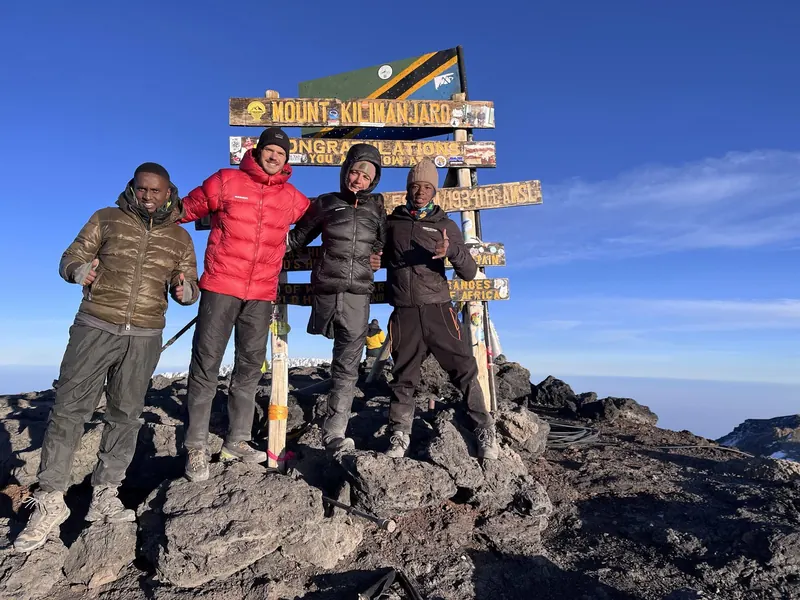
Jaynevy Tours runs this 7 day Rongai route climb from Moshi, near Kilimanjaro. You start with a morning pickup in Moshi town, drive to Rongai Gate on the north side near the Kenyan border, and camp at Simba, Second Cave, Kikelewa, Mawenzi Tarn and Kibo. Summit night starts at midnight from Kibo Camp, with Gilman's Point and Uhuru Peak, the highest point in Africa. The descent goes down the Marangu side through Horombo to Marangu Gate, then back to Moshi.
The listing is new and has no reviews yet, so there are few reports from past climbers to read. GetYourGuide platform terms still apply, including free cancellation up to 24 hours before departure for a full refund and a reserve now, pay later option. Weather and altitude decide if you reach the top, and no listing can promise a summit.
$2,000 per person. It covers park fees and taxes, trekking permits, guide, cooks and porters, all meals on the trek, drinking water and hot drinks, and camping equipment with tents and sleeping mats.
7 days, with walking days of 3 to 5 hours and 5 to 9 km before a midnight summit start.
Morning pickup in Moshi town, then a drive to Rongai Gate. You return to Moshi at the end.
Uhuru Peak, named as the highest point in Africa. The listing does not give a height, and the summit is 5,895 m (19,341 ft) according to Wikipedia.
Flights to and from Tanzania, round-trip airport transfers, hotel nights before and after the climb, visa fees, travel insurance, personal gear hire, tips for guides, porters and cooks, and meals in Moshi.
Free cancellation up to 24 hours before departure for a full refund, with a reserve now and pay later option.
Check Dates and Availability
Starting times are shown once you pick a date. Pickup in Moshi town is included.
Quick answer The short answer
The 7 day Rongai route climb costs $2,000 per person with Jaynevy Tours on GetYourGuide, and park fees and permits are in the price. Airport transfers and hotel nights in Moshi are not. The listing is new and has no reviews yet.
Key takeaways
- See what the price covers in the what is included section before you compare it with other listings.
- Read the route day by day from Rongai Gate to Uhuru Peak and down to Marangu Gate.
- The listing states no reviews yet. If you want a Rongai climb with 57 reviews, look at the Altezza 7 day Rongai climb.
- Compare all Kilimanjaro climbing tours on price, inclusions and review count before booking.
What the Price Actually Covers
The $2,000 per person price covers the mountain itself and the crew. Everything around the climb, from the airport to your hotel bed, is on you.
Included and Not Included
The listing is clear about what is in the price. Mount Kilimanjaro park fees and taxes, Kilimanjaro trekking permits, professional guides, cooks and porters, breakfast, lunch and dinner during the trek, drinking water and hot drinks, all camping equipment with tents and sleeping mats, first aid kits and emergency oxygen, and transfers to and from the Kilimanjaro National Park gate.
What is not included matters just as much. Round-trip airport transfers and accommodation before and after the climb are listed as exclusions, so you book your own Moshi hotel and your own taxi from Kilimanjaro International Airport (JRO). Visa fees, travel insurance, personal climbing gear, available for rent, tips for guides, porters and cooks, optional activities and meals in Moshi, and items of a personal nature are all excluded too.
The honest note here is that the gap between the card price and your real total can be wide. Tips alone are commonly advised at $250 to $300 per hiker on seven-day climbs according to one operator, and a hotel night in Moshi plus two airport transfers add more. Plan for those costs before you book.
| Line | In the price | Notes |
|---|---|---|
| Park fees and taxes | Yes | Mount Kilimanjaro park fees and taxes listed as included |
| Trekking permits | Yes | Kilimanjaro trekking permits included |
| Crew | Yes | Professional mountain guides, cooks and porters |
| Meals and drinks | Yes | Breakfast, lunch and dinner on the trek, plus drinking water and hot drinks |
| Camping equipment | Yes | Tents and sleeping mats, not sleeping bags |
| First aid and oxygen | Yes | First aid kits and emergency oxygen included |
| Airport transfers | No | Round-trip transfers are a listed exclusion |
| Hotel nights in Moshi | No | Accommodation before and after the climb not included |
| Crew tips | No | Tips for guides, porters and cooks excluded |
| Visa and insurance | No | Both listed as exclusions, bring your own |
| Personal gear | No | Available for rent, sleeping bag on the bring list |
Sources: Wikipedia, Mount Kilimanjaro, UNESCO, Kilimanjaro National Park
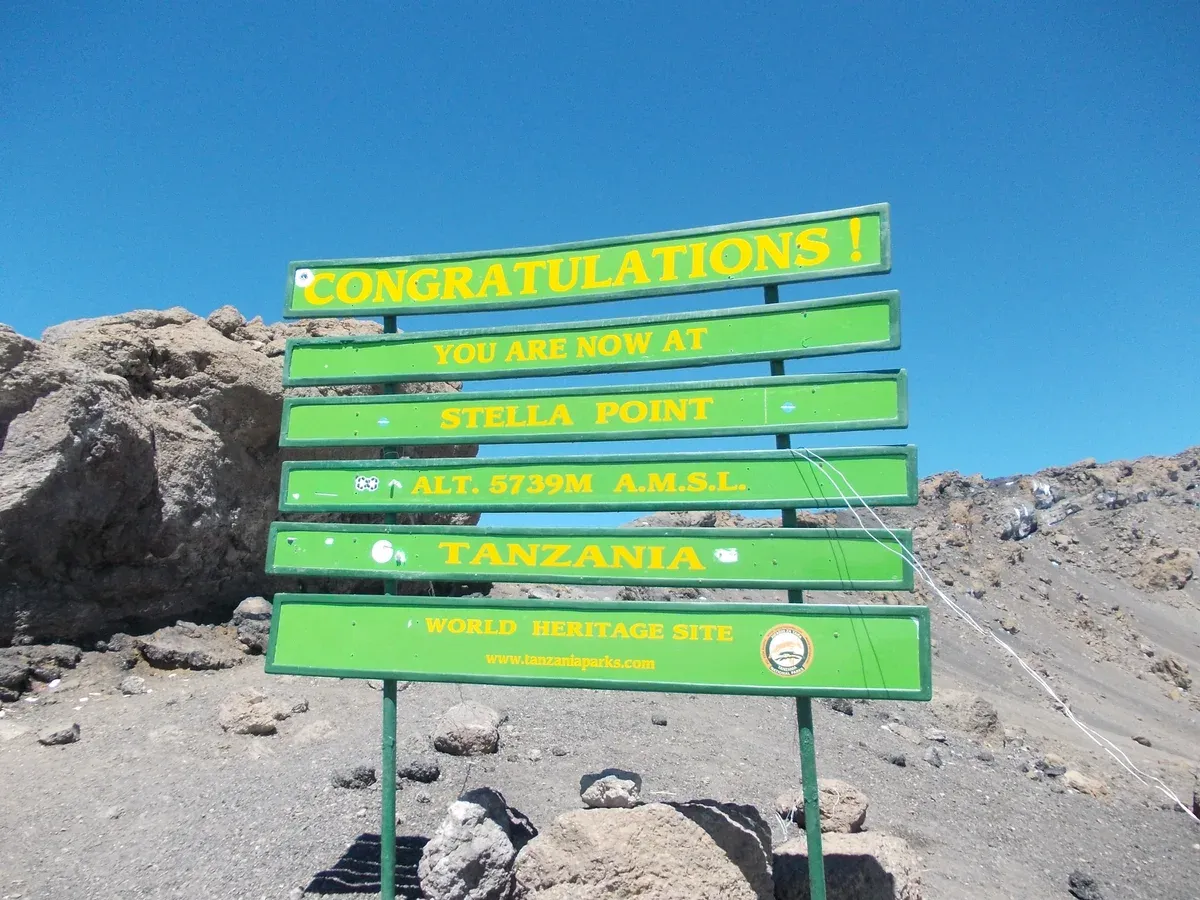
The Stella Point sign on the crater rim. Photo: Caelo80, CC BY-SA 3.0, via Wikimedia Commons
The Route Day by Day
The itinerary follows the Rongai trail from the north side near the Kenyan border, crosses the alpine desert between Kibo and Mawenzi, and descends the Marangu Route. Camp heights are not stated in the listing, so only walking times, distances and named stops below come from it.
Seven Days, Five Camps, Two Gates
Day 1 starts with morning pickup in Moshi and a drive to Rongai Gate. Porters collect your luggage and you walk 3 to 4 hours over 6.5 km through montane forest to First Cave, also called Simba Camp. Day 2 is a 3 to 5 hour hike of 5 km through moorland to Second Cave Camp, with views toward the Kibo cone and the eastern ice fields when the weather allows.
Day 3 runs 9 km in 3 to 4 hours to Kikelewa Camp. Day 4 is the acclimatisation day, a 3 to 4 hour hike of 6 km up steep slopes into the alpine desert to Mawenzi Tarn Camp at the base of the Mawenzi cone. The listing calls this an extra day for acclimatization. Day 5 is the longest walking day, 9 km in 4 to 5 hours across ridges between the Kibo and Mawenzi cones to Kibo Camp, your last camp before the summit.
Summit night starts at midnight. You climb steep scree or snow to Gilman's Point on the crater rim, then continue to Uhuru Peak, the highest point in Africa. After the summit you descend the Marangu Route, stopping at Kibo Hut for lunch, then continue to Horombo for the night. Day 7 walks down past Mandara Hut to Marangu Gate, where you meet your porters and return to Moshi. No summit or view is guaranteed, weather and altitude decide.
| Day | Route | Height |
|---|---|---|
| 1 | Moshi to Rongai Gate, 6.5 km walk to First Cave (Simba) Camp | Not stated in the listing |
| 2 | First Cave to Second Cave Camp, 5 km | Not stated in the listing |
| 3 | Second Cave to Kikelewa Camp, 9 km | Not stated in the listing |
| 4 | Kikelewa to Mawenzi Tarn Camp, 6 km, acclimatisation day | Not stated in the listing |
| 5 | Mawenzi Tarn to Kibo Camp, 9 km | Not stated in the listing |
| 6 | Midnight start to Gilman's Point and Uhuru Peak, then down to Horombo | Uhuru Peak, highest point in Africa, height not stated in the listing |
| 7 | Horombo past Mandara Hut to Marangu Gate, return to Moshi | Not stated in the listing |
Who This Trip Rules Out
This listing states clear limits. Several of them push travellers toward other tours on this site, and each case has a linked alternative.
Stated Limits and What to Pick Instead
The listing is not suitable for people with mobility impairments, heart problems, respiratory issues or altitude sickness. That last one matters on a climb that spends days at altitude. No minimum age is stated and no group size is stated, so ask the operator both questions before booking if either matters to you.
Fitness is a real filter. Walking days run 3 to 5 hours over 5 to 9 km, then a midnight summit start on steep scree. The listing itself says a good level of fitness is required. If you want a longer acclimatisation profile look at the 8 day Lemosho climb with an extra day on the mountain.
The from-price does not cover airport transfers or hotel nights in Moshi, so you carry those costs and the logistics yourself. If you want those in the price, the Altezza Rongai climb includes two hotel nights and airport transfers, at a higher price. If you want proof from past climbers, this listing is new with no reviews yet, while the budget Marangu hut climb and the budget 7 day Lemosho climb are cheaper GetYourGuide alternatives, though they also have few reviews. Anyone who cannot face a night in a tent should note that this listing includes tents and sleeping mats, unlike the hut-based Marangu.
Altitude, Season and Paperwork
The practical side, from park fees and visas to summit night cold and acclimatisation. The figures below come from published sources.
Season and Altitude
Operators name January to mid-March and June to October as the dry climbing seasons, with the rains in late March to May and November. Wikipedia gives the average summit temperature as about minus 7 degrees Celsius, and one operator guide puts summit zone nights at minus 20 to minus 10 C. Summit night starts at midnight from camp, and you should expect only a short stay on top before descending.
Altitude is the main reason climbs fail. Wikipedia defines very high altitude as 3,500 to 5,500 m, and this route spends days there. About 40 percent of people get acute mountain sickness after rapidly going to 3,000 m, and it starts with a headache plus nausea, loss of appetite or fatigue. HAPE and HACE are the severe forms and both can be fatal. Walk slowly, drink, and tell your guide early. Seven-day itineraries historically reached the summit more often than five-day ones in a 2006 park dataset, though that data is old and unverified. There is no published success rate for this specific operator.
| Item | Figure | Source |
|---|---|---|
| Conservation fee | US$70 per person per day, ages 16 and over, plus 18 percent VAT per the booklet | TANAPA tariff |
| Public campsite fee | US$50 per person per night, ages 16 and over | TANAPA tariff |
| Crew tips | About US$250 to US$300 per hiker on seven-day climbs, operator advice only | Nafika Tours listing |
| Visa | US$50 single entry, US$100 multiple entry, applied for online | Tanzanian embassy |
| Insurance | Cover trekking up to 6,000 m with helicopter evacuation | Operator requirements |
Getting There and Paperwork
Fly into Kilimanjaro International Airport (JRO), which sits about 40 km from Moshi according to Wikipedia. Airport transfers are not included in this tour, so arrange your own taxi or hotel shuttle. Remember the transfer to Rongai Gate on day 1 is included, since the listing covers gate transfers.
Get the Tanzanian visa online through the e-visa system, paying by card or bank transfer. Buy travel insurance that covers trekking to 6,000 m with evacuation, because, as one operator notes, the park rescue fee does not cover a full helicopter evacuation. Altezza Travel recommends exactly that cover on its own listings. Bring a sleeping bag, warm clothing, hiking pants and personal medication, all on the listing's bring list. For more background, read the guide to the best time to climb Kilimanjaro and the page on Moshi Tanzania before you book.
Itinerary in Phases
The listing numbers the days, so the day numbers below are its own. Times of day other than the midnight start are not stated.
-
Day 1
Moshi to Rongai Gate
Morning pickup in Moshi town, drive to Rongai Gate, and a 3 to 4 hour walk of 6.5 km through montane forest to First Cave, also called Simba Camp.
-
Day 2
Into the moorland
A 3 to 5 hour hike of 5 km to Second Cave Camp, with views of the Kibo cone and the eastern ice fields when the sky is clear.
-
Day 3
To Kikelewa Camp
A 3 to 4 hour hike of 9 km through moorland to Kikelewa Camp, with the Kibo and Mawenzi cones ahead.
-
Day 4
Acclimatisation at Mawenzi Tarn
A 3 to 4 hour hike of 6 km up steep slopes into the alpine desert, ending at Mawenzi Tarn Camp below the Mawenzi cone. This extra night is the acclimatisation day.
-
Day 5
Across to Kibo Camp
The longest walking day, 4 to 5 hours over 9 km on ridges between the Kibo and Mawenzi cones, to Kibo Camp, the last camp before the summit.
-
Midnight, day 6
Summit night
Start at midnight, climb steep scree or snow to Gilman's Point on the crater rim, continue to Uhuru Peak, then descend the Marangu Route with a lunch stop at Kibo Hut and the night at Horombo.
-
Day 7
Down to Marangu Gate
Walk from Horombo past Mandara Hut to Marangu Gate, meet your porters, and return to Moshi.
Pros and Cons
A straight read of this listing against the other Rongai and Lemosho options on the site.
What we genuinely like
- Park fees, taxes and trekking permits are in the $2,000 price
- Seven days with an extra acclimatisation night at Mawenzi Tarn Camp
- The Rongai trail is the only route approaching from the north, so it stays quiet
- Guides, cooks, porters, meals on the mountain, tents, sleeping mats, first aid kits and emergency oxygen are all included
- Free cancellation up to 24 hours before departure and a reserve now, pay later option
The honest downsides
- The listing is new with no reviews yet, so there are no reports from past climbers to read
- Airport transfers and hotel nights in Moshi are excluded, so you arrange and pay for them yourself
- Tips for guides, porters and cooks are excluded, and operators commonly advise $250 to $300 per hiker on a seven-day climb
- Camping equipment rather than huts, and a sleeping bag is on your own bring list
- The descent uses the Marangu Route, so you do not come back down the quiet north side
Who it's NOT for: Not for anyone who wants a reviewed operator, hut beds, or airport transfers and hotel nights wrapped into one price.
Questions About This 7 Day Rongai Route Climb
How much does this 7 day Rongai route climb cost?
It costs $2,000 per person with Jaynevy Tours on GetYourGuide, all taxes and fees included on the listing. Park fees and permits are in that price. For the full cost picture including tips and fees, see the page on the cost to climb Kilimanjaro.
What is not included in the price?
Flights, round-trip airport transfers, hotel nights before and after the climb, visa fees, travel insurance, personal gear hire, crew tips and meals in Moshi are all listed as exclusions. Compare what other packages cover in the comparison table on the homepage.
How hard is the walking?
The listing gives walking days of 3 to 5 hours and 5 to 9 km, then a midnight summit start on steep scree or snow. It states that a good level of fitness is required. Route profiles are compared in the guide to Kilimanjaro routes.
Does the itinerary include an acclimatisation day?
Yes. Day 4 is an extra acclimatisation day with a 3 to 4 hour, 6 km hike to Mawenzi Tarn Camp at the base of the Mawenzi cone, and the night is spent there. More on why this matters is in the guide to how long it takes to climb Kilimanjaro.
How high does this climb go?
To Uhuru Peak, which the listing names as the highest point in Africa, though it does not state the height. Published figures put the summit at 5,895 m (19,341 ft). Read more on the Uhuru Peak page.
Where do I sleep during the climb?
In tents with sleeping mats, as the listing includes all camping equipment but not a sleeping bag, which is on your bring list. The hut alternative is covered in the Marangu route comparison.
Can I cancel if my plans change?
Yes. Free cancellation up to 24 hours before departure for a full refund, and you can reserve now and pay later. That is a GetYourGuide platform term on this listing. If you want a Rongai climb with an established review record instead, see the Altezza 7 day Rongai climb.
Prices, availability and terms are set by the operator and confirmed at checkout.
We may earn a commission if you book through one of our links, at no extra cost to you. Full affiliate disclosure