 Kilimanjaro Climbing Tours
Kilimanjaro Deaths: How Risky Is the Climb, Really?
Kilimanjaro deaths are real, and the numbers behind them are worth reading calmly. This page collects the published estimates, names the sources behind each one, and explains what actually kills people on the mountain: altitude illness, falls, rockfall and heart conditions. It also covers the crew, since porters face risks that climbers rarely hear about. You will find the Arrow Glacier rockfall, the Western Breach closure, how rescue works, what the rescue fee covers, and the practical steps that lower risk. When you are ready to compare trips, the Kilimanjaro climbing tours comparison table lists climbs by route and duration, and the how long to climb Kilimanjaro guide explains why day counts matter so much for safety.
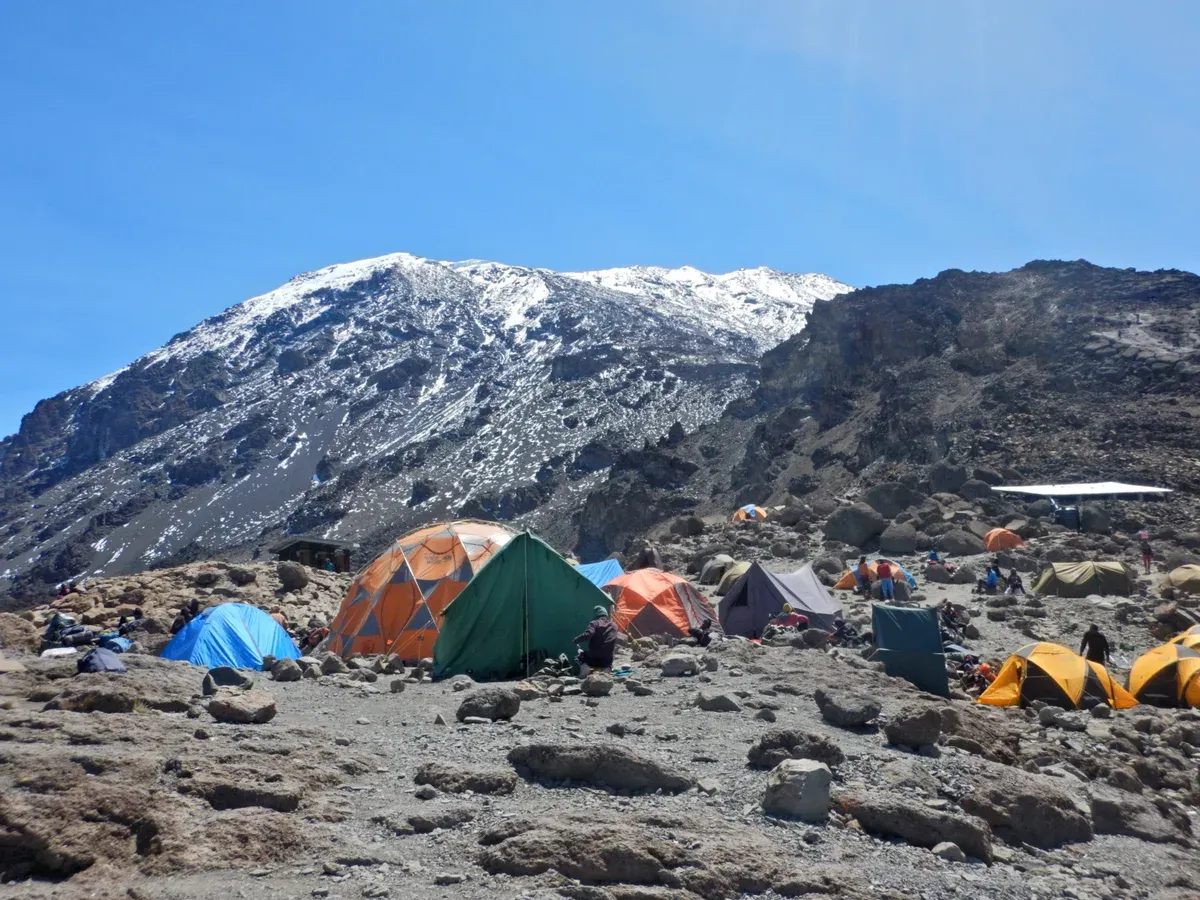
Barafu Camp. Photo: Markventure Tour Guide, CC BY-SA 4.0, via Wikimedia Commons
Quick answer The numbers in brief
No official count exists, but a study reported by Wikipedia recorded 25 deaths on Kilimanjaro between January 1996 and October 2003, a mortality rate of 13.6 per 100,000 climbers. MountainIQ estimates about 3 to 10 deaths per year including porters. In that study 14 of the 25 deaths came from advanced altitude illness, and the practical fixes are well known: longer itineraries, a strict turnaround rule, proper insurance and a responsible operator.
Key takeaways
- The best documented figure is the Kilimanjaro Christian Medical Centre study of 25 deaths from 1996 to 2003, detailed in the numbers section.
- Pick a longer itinerary to cut altitude risk, for example the Northern Circuit Route 8 Days or the Lemosho Route 8 Days.
- Altitude sickness in daily practice, from symptoms to Diamox, is covered in the climbing Mount Kilimanjaro guide.
- Rescue on the mountain has limits. See how evacuation works and what it costs in lowering the risk.
How Many People Die on Kilimanjaro
There is no official TANAPA death count. Everything published comes from a hospital study, a medical charity or an operator, and the figures disagree.
The Estimates, Side by Side
The most serious number comes from a retrospective study at Kilimanjaro Christian Medical Centre, reported by Wikipedia. It recorded 25 deaths from January 1996 to October 2003, about eight years, and worked out an overall mortality rate of 13.6 per 100,000 climbers. The other figures are estimates.
MountainIQ puts the toll at about 3 to 10 deaths per year including porters, based on roughly 30,000 climbers and 80,000 porters and guides on the mountain each year, and works out a risk of about 0.009 percent per person. Kilimanjaroroutes.com claims an average of about 10 deaths per year, and 10 to 15 in its FAQ, without naming a source, and its own arithmetic applying 13.6 per 100,000 to roughly 40,000 climbers gives about 5.4 deaths annually. Duma Explorer gives a fatality rate of about 0.03 percent.
A 2013 World Bank report went further and estimated that as many as 20 guides and porters died on Kilimanjaro routes each year, a figure that counts only the crew.
| Estimate | Period | Source |
|---|---|---|
| 25 deaths, 13.6 per 100,000 climbers | January 1996 to October 2003 | Kilimanjaro Christian Medical Centre study, reported by Wikipedia |
| About 3 to 10 deaths per year including porters | Annual estimate | MountainIQ |
| About 10 per year, 10 to 15 in its FAQ | Annual claim, no source named | Kilimanjaroroutes.com |
| About 5.4 deaths per year | Its own arithmetic from the 13.6 rate and 40,000 climbers | Kilimanjaroroutes.com |
| About 0.03 percent fatality rate | Annual rate | Duma Explorer |
| As many as 20 guides and porters per year | 2013 estimate | World Bank report, cited by Alpinist |
What the Study Found
The Kilimanjaro Christian Medical Centre study is worth reading closely because it counts hospital cases. Of the 25 deaths, 14 came from advanced high-altitude illness and 11 from other causes. The dead were 17 women and 8 men, aged 29 to 74.
Among the deaths not caused by altitude, Wikipedia lists trauma, heart attack, pneumonia, other cardiopulmonary failure and appendicitis. The 13.6 per 100,000 rate is the number most often quoted, and it is a snapshot of one hospital over roughly eight years, not a live park statistic. Neither TANAPA nor any government body publishes an annual Kilimanjaro death toll, so any yearly figure you read, including on this page, is attributed to somebody's estimate and not to the park.
Sources: Wikipedia, MountainIQ, Kilimanjaroroutes.com, Alpinist
The Causes
Four groups of causes appear in the sources: altitude illness, falls and rockfall, heart conditions, and risks that fall mainly on the crew.
Altitude Illness
Kilimanjaro's summit at 5,895 m (19,341 ft) sits in what Wikipedia classes as extreme altitude, above 5,500 m. Severe forms are HAPE, fluid in the lungs, and HACE, swelling of the brain, and both can be fatal. Wikipedia says immediate descent is the only definite and reliable treatment for severe AMS, HACE and HAPE.
How common is the milder form? A retrospective study of 917 Lemosho or Machame climbers found 70.4 percent had acute mountain sickness, and a July and August 2005 study found 77 percent had AMS while only 61.3 percent reached the summit. MountainIQ lists acute mountain sickness, HAPE, HACE, rockfall, hypothermia and heart attacks among the causes of death.
Duma Explorer says HAPE caused 76 percent of deaths in one unnamed study. The practical control is sleeping altitude. Wikipedia says sleeping altitude should not rise by more than 300 m (1,000 ft) per day at high altitude, which is why MountainIQ advises a longer itinerary.
- About 70.4 percent of 917 Lemosho or Machame climbers had acute mountain sickness in one study reported by Wikipedia.
- A 2005 study found 77 percent with AMS and a 61.3 percent summit rate.
- Above 5,300 m, SummitClimb notes, the body can no longer acclimatise permanently.
- Immediate descent is the only reliable treatment for severe AMS, HACE and HAPE.
Falls and the Arrow Glacier Rockfall
Trauma appears in the study's death list, and the best documented event is a rockfall on the Western Breach. The Mail & Guardian reported on 5 January 2006 that a rockslide killed three climbers. Alpinist says the January 2006 rockfall killed three American climbers and injured four porters at or above Arrow Glacier Camp.
Sources date it to 4 January 2006, put the rock mass at roughly 39 tons, and blame melting ice that had held the rocks in place. Park authorities closed the Western Breach until December 2007 and required groups to climb earlier in the day on reopening. Accounts disagree on whether the victims were asleep in their tents or on the move, and on whether a 2015 rockfall killed one or three.
Rockfall returned in 2014, when a Western Breach party carried an injured client with a broken ankle about 5 km to Lava Tower Camp for a helicopter pickup. Wikipedia says the Arrow Glacier and Western Breach route was closed again as of 20 January 2024, Altezza Travel says it has been closed since 2024, and Climb Mount Kilimanjaro says it is closed with no reopening date. Treat it as closed.
- 4 January 2006: a rockfall of roughly 39 tons killed three climbers near Arrow Glacier Camp.
- The route reopened in December 2007 with earlier start times required.
- Wikipedia lists the Western Breach as closed again as of 20 January 2024.
Heart Conditions
Heart attack and other cardiopulmonary failure appear by name in the Kilimanjaro Christian Medical Centre study's list of non-altitude deaths. Altezza Travel lists the climb as not recommended for people with poor cardiovascular health. Anyone with a heart condition, high blood pressure or a history of cardiac problems should be cleared by a doctor before booking, and should say so on the booking form so the guiding team knows.
Porters and the Crew
The crew carries risk too. MountainIQ says porters suffer more hypothermia because they often carry no spare clothing. The 2013 World Bank report counted about 400 guides, 10,000 porters and 500 cooks working seasonally on the mountain and estimated as many as 20 crew deaths per year.
A guide told Alpinist that only about 20 percent of companies train porters in wilderness first aid, and that outfitters generally do not pay for helicopter evacuations of workers. Standards do exist. KPAP, founded in 2003 and based in Moshi, caps porter loads at 20 kg (about 44 lb) excluding personal kit, requires a minimum wage of TZS 20,000 per day paid within two days, three meals a day, and at least three porters per climber, or two on Marangu.
In 2022, porters at KPAP-affiliated companies averaged TZS 36,074 per day against TZS 25,860 at non-affiliated operators, per Wikipedia. Duma Explorer claims about 70 percent of expeditions do not meet KPAP standards, and warns that some companies show KPAP logos without being certified partners. Choosing a KPAP partner is part of choosing a safe operator.
Lowering the Risk
Almost every documented death traces back to a controllable factor: too few days, a missed turnaround, thin insurance or a careless operator.
Choose More Days
Day count is the first thing to check. MountainIQ advises a 7 to 8 day itinerary and 3 to 4 litres of water a day to reduce altitude risk, and the acclimatisation rule of no more than 300 m (1,000 ft) of sleeping-altitude gain per day points the same way. Five-day climbs compress the profile and studies show most climbers on standard routes get acute mountain sickness anyway.
The Lemosho Route 7 Days at $3,959 per person builds in profile with oxygen and Wilderness First Responder guides, and the Northern Circuit Route 8 Days at $4,554 per person is the longest route on the mountain. For a budget option with the same seven-day profile, the Lemosho Route 7 Days Budget at $1,960 per person includes park fees, rescue fees, VAT and emergency oxygen.
- MountainIQ advises 7 to 8 days on the mountain.
- Wikipedia's acclimatisation rule: no more than 300 m (1,000 ft) of sleeping-altitude gain per day.
- The Lemosho Route 8 Days at $3,200 per person adds a full acclimatisation day.
Respect the Turnaround
Summit night is where stubbornness turns dangerous. Because immediate descent is the only reliable treatment for severe altitude illness, a hard turnaround time matters more than the summit. Altezza Travel says its guides may skip Lava Tower and use the porter trail topping out at about 4,400 m if someone is not acclimatising, which is the same logic applied lower on the mountain.
Adventure Consultants says it monitors every climber daily with standard altitude-illness assessments and descends anyone with serious symptoms. Ask any operator before booking what their turnaround rule is and whether their guides carry the authority to enforce it without debate.
- Descent is the only definite treatment for severe AMS, HACE and HAPE, per Wikipedia.
- Good operators check oxygen saturation and pulse daily and turn people around when needed.
Insurance and What Rescue Actually Costs
The park rescue fee does not cover a full helicopter evacuation, as Footslopes Tours points out. One operator lists a rescue fee of about US$20 per person per trip that excludes helicopter evacuation, and others put a helicopter evacuation at US$5,000 to US$10,000. Duma Explorer says an uninsured evacuation typically costs US$3,000 to US$10,000 or more, and repatriation can run US$20,000 to US$100,000.
It also warns that standard travel insurance often caps altitude cover near 3,000 m and recommends cover to at least 5,895 m with US$100,000 of emergency medical. Operators agree: Follow Alice requires insurance covering hiking up to 6,000 m, and Altezza Travel recommends mountaineering cover to 6,000 m (19,685 ft) including helicopter evacuation. Note that insurance is listed as an exclusion in Altezza, Zara Tours and Kilinge Adventures listings, so you buy it yourself.
| Item | Figure | Source |
|---|---|---|
| Park rescue fee | About US$20 per person per trip, excludes helicopter evacuation | Operator listing via Jaynevy Tours |
| Uninsured helicopter evacuation | US$3,000 to US$10,000 or more | Duma Explorer |
| Other operator estimate for evacuation | US$5,000 to US$10,000 | Jaynevy Tours |
| Repatriation | US$20,000 to US$100,000 | Duma Explorer |
| Recommended insurance cover | To 5,895 m with US$100,000 emergency medical | Duma Explorer |
How Evacuation Works on the Mountain
Duma Explorer names KiliMedAir as the helicopter evacuation provider authorised by TANAPA, working directly with Global Rescue, AXA, True Traveller and Allianz. A helicopter can be airborne 5 to 15 minutes after a call, flies 20 to 45 minutes to the mountain, and takes 1 to 2 hours from call to hospital. Where there is no helicopter, a stretcher carry from the upper camps can take 6 hours or longer, and Shira Camp is about 90 minutes from the gate by rescue vehicle.
Helicopter evacuation points sit at Horombo 3,720 m, Millennium 3,820 m, Shira 3,840 m, Barafu about 4,600 m and Kosovo 4,900 m. Helicopters carry their own risk: on 24 December a rescue helicopter crashed near Barafu Camp and all five on board died, including two Czech tourists, a Tanzanian guide and doctor, and the pilot. The Tanzania Civil Aviation Authority opened an investigation, and reports gave the operator as KiliMedAir or Kilimanjaro Aviation and the altitude as 4,000 to 4,700 m.
Reports say the previous recorded aircraft accident on the mountain was in November 2008, when four people died.
Pick the Operator, Not Just the Price
Operator choice affects both your safety and the crew's. Ask three questions before paying. First, is the company a certified KPAP partner, since Duma Explorer says some display the logo without certification and KPAP partners must hold an 85 percent rating over six months to stay listed.
Second, what medical kit, oxygen and daily health checks come as standard, since some listings carry pulse oximeters, first aid kits and emergency oxygen while Zara Tours' Machame listing names emergency oxygen as not included. Third, how many days, because a five-day climb gives less time to acclimatise. The park rescue fee does not cover the helicopter.
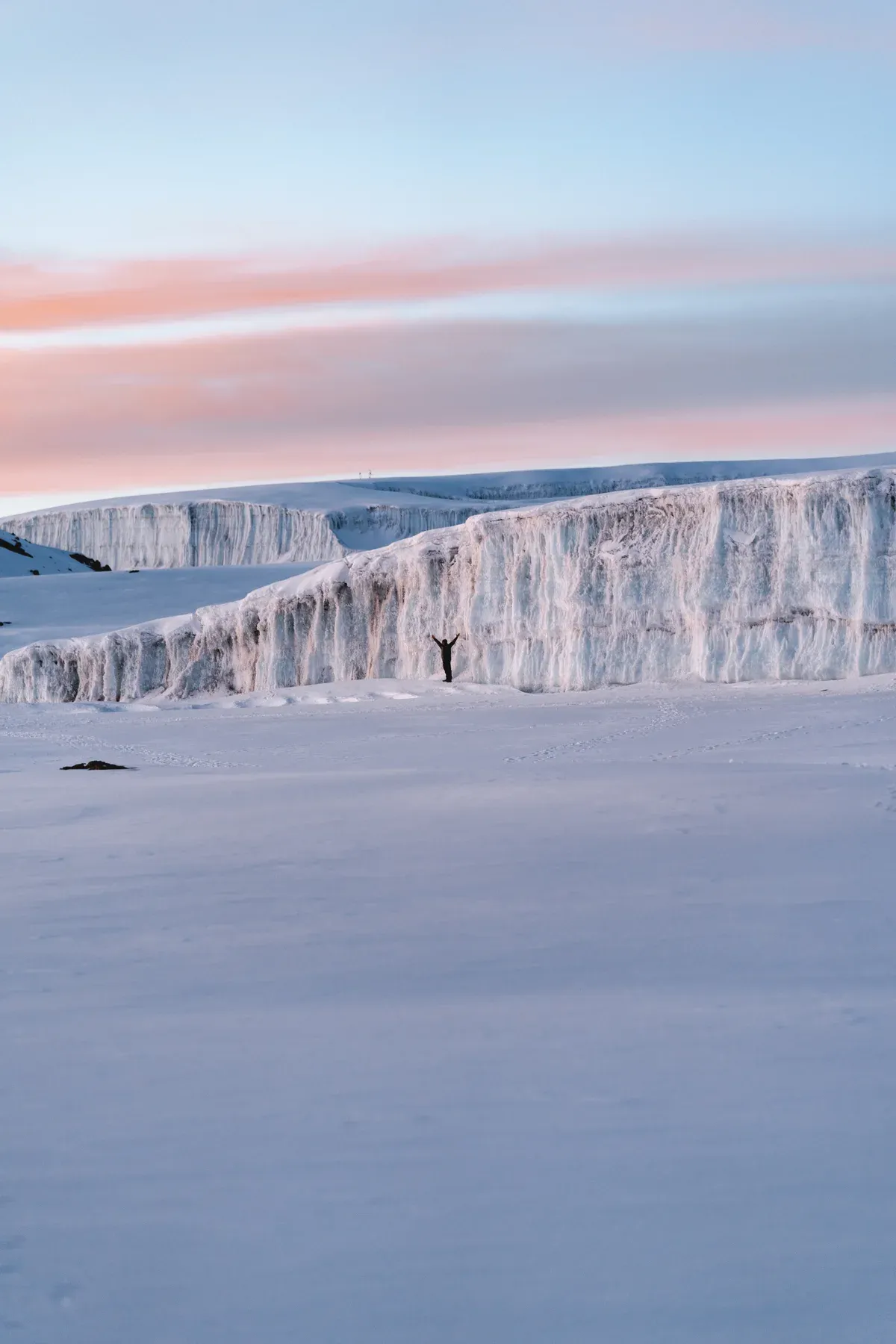
The Furtwängler Glacier in the Kibo crater. Photo: Altezzatravel, CC BY-SA 4.0, via Wikimedia Commons
Do and Don't
Do
- Do book at least 7 days on the mountain, because MountainIQ advises a 7 to 8 day itinerary to reduce altitude risk and Wikipedia's rule caps sleeping-altitude gain at 300 m (1,000 ft) per day.
- Do buy insurance that covers trekking to 6,000 m including helicopter evacuation, because the park rescue fee of about US$20 per person excludes the helicopter and an uninsured evacuation can cost US$3,000 to US$10,000 or more.
- Do ask whether your operator is a certified KPAP partner, because Duma Explorer says some companies show KPAP logos without certification and KPAP partner guidelines require a 20 kg load cap and a TZS 20,000 minimum daily wage.
- Do ask your doctor about acetazolamide before the trip, because Wikipedia gives a preventive dose of 125 mg twice daily citing the CDC for rapid ascents above 2,700 m, and Altezza Travel tells climbers to confirm with a family doctor that it is safe.
- Do drink over 4 litres of water a day and avoid alcohol and caffeine on the mountain, because this is the advice Altezza Travel gives its climbers for acclimatisation.
Don't
- Don't plan to climb the Western Breach, because Wikipedia lists the Arrow Glacier route as closed as of 20 January 2024 after a rockfall history that includes three deaths in January 2006.
- Don't argue with the guide's turnaround decision, because immediate descent is the only definite and reliable treatment for severe AMS, HACE and HAPE.
- Don't assume a cheap short itinerary saves money safely, because five-day climbs compress acclimatisation and studies found acute mountain sickness in about 70 to 77 percent of climbers on standard routes.
- Don't rely on standard travel insurance, because Duma Explorer says standard policies often cap altitude cover near 3,000 m, far below the 5,895 m summit.
Kilimanjaro Deaths: Questions
How many people die climbing Kilimanjaro each year?
There is no official count. MountainIQ estimates about 3 to 10 deaths per year including porters, and Kilimanjaroroutes.com claims about 10 without naming a source. The best documented figure is the Kilimanjaro Christian Medical Centre study of 25 deaths over roughly eight years, detailed in the numbers section.
What is the risk of dying on Kilimanjaro per climb?
The 1996 to 2003 study gives a mortality rate of 13.6 per 100,000 climbers, and MountainIQ works out about 0.009 percent per person from about 110,000 climbers and crew a year. Duma Explorer gives about 0.03 percent. All are attributed estimates, none is an official park statistic, as the causes section explains.
Is Kilimanjaro dangerous compared to other mountains?
It is a high trek, not a technical climb, and all visitors must be accompanied by a TANAPA-registered guide since at least 1991 per Alpinist. The danger is altitude, not rope work, and in the hospital study above 14 of 25 deaths came from advanced altitude illness. Comparisons with Everest are outside this page, but the routes compared on the homepage show how route and day count change the risk profile.
Do you need oxygen to climb Kilimanjaro?
Oxygen is not part of every package, but several operators carry an emergency cylinder. ZAFS Tours states all its climbs carry emergency oxygen, Habari Adventure lists emergency oxygen and a pulse oximeter, and Zara Tours' Machame listing names oxygen as not included, so ask before booking. More on acclimatisation is in the climbing Mount Kilimanjaro guide.
Is the Western Breach route open?
No. Wikipedia says the Arrow Glacier and Western Breach route was closed again as of 20 January 2024, Altezza Travel says it has been closed since 2024, and Climb Mount Kilimanjaro reports no reopening date. The route's rockfall history is covered in the causes section.
Are porters at risk on Kilimanjaro too?
Yes. A 2013 World Bank report estimated as many as 20 guides and porters died on the routes each year, and MountainIQ says porters suffer more hypothermia because they often carry no spare clothing. KPAP standards, a 20 kg load cap and a TZS 20,000 minimum daily wage exist to change this, and the comparison of Kilimanjaro tours shows what each operator includes.