 Kilimanjaro Climbing Tours
Marangu Route: 5-Day Hut Climb with Zara Tours
The marangu route is the only Kilimanjaro path that sleeps in huts at every camp, and this 5-day shared climb from Zara Tours puts the whole hut experience in one price. It costs $2,402.60 per person and covers park fees, hut fees, rescue fees, all meals on the mountain and two nights at the Springlands Hotel in Moshi. You walk the same trail up and down from Marangu Gate, sleep at Mandara, Horombo and Kibo huts, and climb to Gilman's Point and Uhuru Peak on summit night. This page breaks down what the price covers, what you pay on top, and who should look at a longer or cheaper listing on Kilimanjaro climbing tours. See all Kilimanjaro climbing tours side by side.
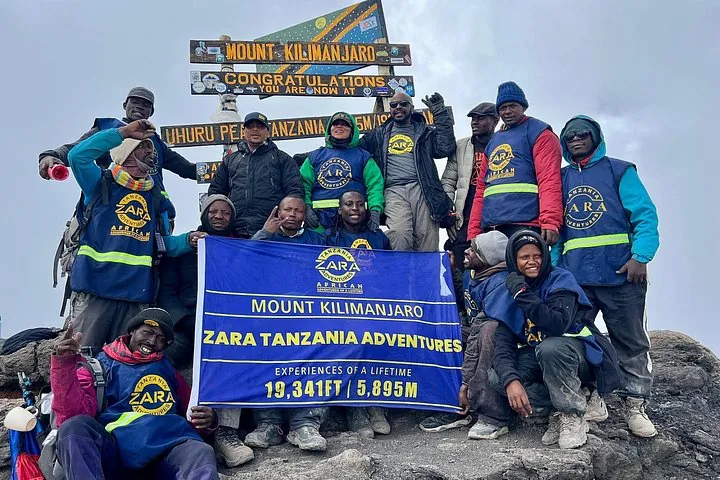
About This Tour
Zara Tours runs this 5-day Marangu route climb as a shared group of up to 15 people. It is the only route on Kilimanjaro with solar-powered sleeping huts at every camp, each bunk with a sponge mattress and pillow. The trail starts and ends at Marangu Gate, so you climb and descend the same path.
The price covers national park fees, hut fees, rescue fees, a qualified guide with porters, a cook and a waiter, all meals on the mountain, boiled water, pulse oximeters, a first aid kit and two nights at the Springlands Hotel in Moshi. Emergency oxygen, sleeping bags, tips and travel insurance are not included.
$2,402.60, covering park fees, hut and rescue fees, the mountain crew, all meals on the mountain and 2 hotel nights in Moshi
5 days, with an option to add a sixth day at Horombo for acclimatisation
Springlands Hotel in Moshi, with airport transfers to and from JRO, then a drive to Marangu Gate
Uhuru Peak, Africa's highest point. Gilman's Point on the crater rim is 5,681 m per Wikipedia, though this listing states 5,861 m
Tips for guides, porters, cook and waiters, sleeping bag hire, emergency oxygen, meals in Moshi, visa fees, insurance and flights
Free cancellation up to 24 hours before departure for a full refund
Check Dates and Availability
Departures are shared groups of up to 15, and starting times vary by date. Check the calendar to see what is open.
You'll confirm the exact date and time on the secure booking page.
Quick answer Marangu route at a glance
This 5-day Marangu route climb costs $2,402.60 per person and sleeps in huts at Mandara, Horombo and Kibo instead of tents. Park fees, hut fees, rescue fees, meals on the mountain and 2 nights at the Springlands Hotel in Moshi are included. Emergency oxygen, sleeping bags and crew tips are not.
Key takeaways
- See the full price breakdown and what you pay on top
- Walk the route day by day from Marangu Gate to Uhuru Peak
- Find this listing on the Kilimanjaro climbing tours compared beside 14 others
- Budget climbers can compare the Marangu Route 5 Days Budget listing
What the Price Actually Covers
The $2,402.60 per person price covers a lot, but several real costs sit outside it. Read the lines below before you book.
In the Price
Zara Tours includes national park fees, hut and camping fees and the rescue fees required by the national park. The TANAPA tariff sets the hut fee at $60 (US$60) per person per night for ages 16 and over and the rescue fee at $20 (US$20) per trip, so those lines are real money. Also included are the guide, porters, cook and waiter with their salaries and entry fees, all meals on the mountain with boiled water, pulse oximeters, a first aid kit, and 2 nights at the Springlands Hotel in Moshi before and after the climb. Airport transfers to and from JRO are in the price too.
The honest note: the hut comfort is real but basic. Bunks are communal, running water exists only at the two lower huts, and Kibo has basic latrines. Bring Tanzanian shillings in small bills if you want soft drinks or beer at the huts, because prices rise with elevation.
| Line | In the price | Notes |
|---|---|---|
| National park, hut and rescue fees | Yes | Required by the national park, booked by the operator |
| Mountain crew | Yes | Qualified guides, porters, a cook and a waiter |
| Meals on the mountain | Yes | Breakfast, lunch and dinner plus boiled water |
| Springlands Hotel, Moshi | Yes | 2 nights, before and after the climb. Single supplement charged except on the 1 person rate |
| Airport transfers | Yes | To and from JRO |
| Sleeping bag | No | Some equipment available for rent from the operator's price list |
| Emergency oxygen | No | Listed as an exclusion |
| Crew tips | No | Given at the gate on the last day |
| Visa, insurance, flights | No | Arrange all three yourself |
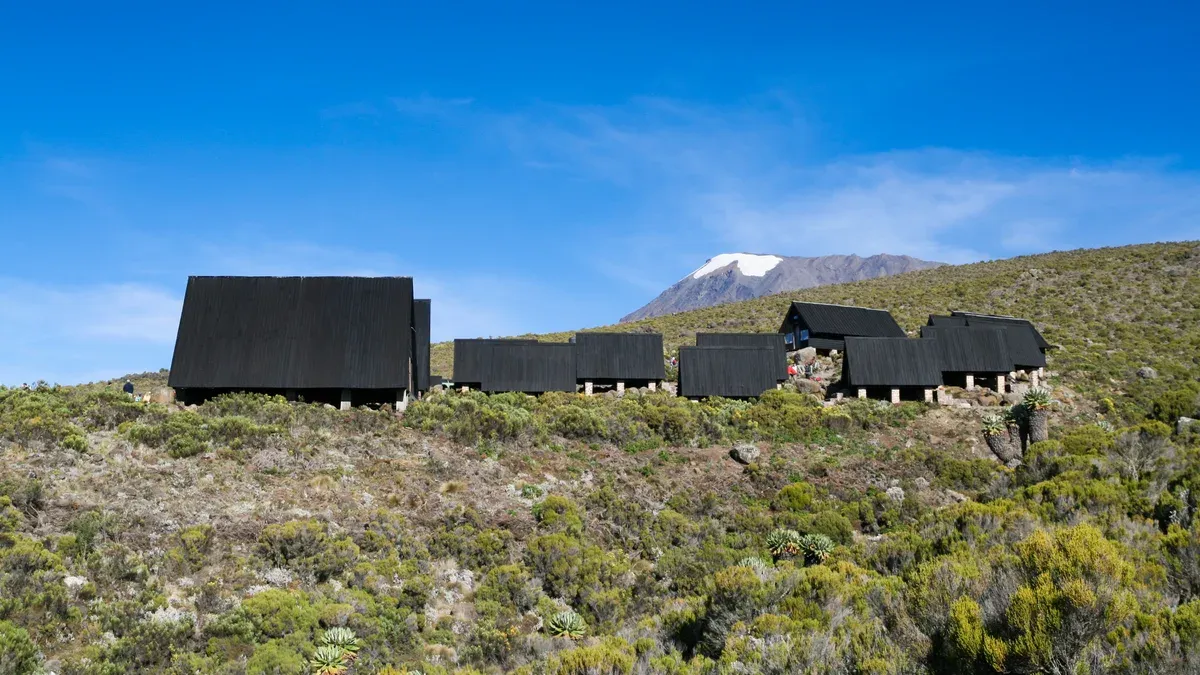
Horombo Huts, with Kibo behind. Photo: Christoph Strässler from Oberdorf BL, Schweiz, CC BY-SA 2.0, via Wikimedia Commons
The Route Day by Day
The Marangu route runs about 64 km per Wikipedia, up and down the same trail from Marangu Gate on the eastern side of the mountain. Here is the 5-day schedule as the listing sets it out.
From the Gate to the Summit and Back
Day 1 leaves Moshi at 9 AM for the 45 minute drive to Marangu Gate, with hiking starting at 10:30 AM through rainforest to Mandara Huts at 2,743 m. Day 2 climbs through heath and moorland to Horombo Huts at 3,760 m, arriving by 3 PM. This is where you feel altitude first, and the listing offers a sixth day here resting or walking toward Mawenzi as an acclimatisation option. Day 3 crosses the saddle between Mawenzi and Kibo to Kibo Huts at 4,730 m, where there is no running water.
Summit night starts with a midnight wake and a 1 AM departure. The plan is Gilman's Point on the crater rim between 5 and 7 AM, then about 2 hours along the rim to Uhuru Peak by 9 AM. Weather and altitude decide if you get there, and no listing can promise a summit. You then descend to Kibo, cross the saddle again to Horombo for the night, and walk down through Mandara to Marangu Gate on day 5, reaching the gate around 2 or 3 PM before the vehicle back to Moshi.
| Day | Route | Height |
|---|---|---|
| 1 | Moshi to Marangu Gate to Mandara Huts | 2,743 m |
| 2 | Mandara to Horombo Huts | 3,760 m |
| 3 | Horombo across the saddle to Kibo Huts | 4,730 m |
| 4 | Kibo to Gilman's Point to Uhuru Peak, then down to Horombo | 5,681 m at Gilman's Point per Wikipedia, the listing says 5,861 m |
| 5 | Horombo through Mandara to Marangu Gate, drive to Moshi | About 1,800 to 1,860 m at the gate |
Why 5 Days Is Short
Wikipedia lists Marangu as a 6-day route, and this listing sells 5. You sleep at Kibo at 4,730 m and go for the summit the same night, with only one full camp night at each hut on the way up. Follow Alice cites a 2006 park-authority dataset giving 27 percent success on 5-day itineraries against 85 percent on 8 days, though that dataset is old and unverified.
If you want a longer schedule, the same operator's Machame route runs 6 days, or look at the 8-day Lemosho Route 8 Days climb, which adds a Shira II camp for better acclimatisation.
Who This Trip Rules Out
Honest limits, with a different listing for each one.
Check These Before Booking
The booking age band runs from 16 to 85, and the listing requires at least a moderate level of physical fitness. It is not recommended for travellers with spinal injuries, poor cardiovascular health or pregnancy. The 5-day format gives less time to acclimatise than most routes on the mountain, which matters because altitude decides who summits.
If the price is the problem, the Marangu Route 5 Days Budget listing costs $1,350 per person on the same huts, but hotel nights in Moshi are not included. If you want a longer climb up a different side of the mountain, the Rongai Route 7 Days gives you more days on the slope. And if the summit is more than you want, the Kilimanjaro 3-Day Trek to Horombo Hut walks this same Marangu trail to 3,720 m and back without attempting Uhuru Peak.
Altitude, Season and Paperwork
The practical side, from published park and aviation sources.
Season and Altitude
The dry climbing seasons run January to mid-March and June to October per Altezza Travel, with rains from late March to May and around November. Summit nights are cold in any month. Wikipedia gives an average summit temperature of about minus 7 degrees Celsius, and Duma Explorer gives minus 20 to minus 10 C in the arctic zone at night. Pack for that, not for the rainforest.
On acclimatisation, Wikipedia defines above 5,500 m as extreme altitude, and Kibo Hut sits at 4,730 m with the summit well beyond that. About 40 percent of people get acute mountain sickness after a rapid ascent to 3,000 m per Wikipedia, and this route gains height fast. The guides carry pulse oximeters and a first aid kit. Watch for a headache with nausea, loss of appetite or fatigue, and use the optional sixth day at Horombo if you can. For more on the seasons, see the best time to climb Kilimanjaro guide.
Fees, Visa and Insurance
Park fees, hut fees and the rescue fee are already in this price, so you do not pay them at the gate. For context, the TANAPA tariff sets the Kilimanjaro conservation fee at $70 (US$70) per person per day, the hut fee at $60 (US$60) per night and the rescue fee at $20 (US$20) per trip, all plus 18 percent VAT per the booklet. Tips are not included. One operator, Nafika Tours, states $250 (US$250) to $300 (US$300) per hiker, and Duma Explorer suggests per-group daily tips of $20 (US$20) to $25 (US$25) for the lead guide.
The Tanzanian embassy lists the ordinary single-entry visa at $50 (US$50) and the multiple-entry visa at $100 (US$100), applied for through the online e-visa system. US passport holders are told by operators to expect the $100 (US$100) multiple-entry visa. Buy travel insurance that covers trekking to 6,000 m with evacuation, because Footslopes Tours notes the park rescue fee does not cover a full helicopter evacuation. Flying in, Kilimanjaro International Airport (JRO) sits about 40 km from Moshi, and the transfers are included. See the Kilimanjaro airport guide for airlines and arrivals, and the cost to climb Kilimanjaro guide for the full money picture.
Sources: TANAPA tariff, Wikipedia on Kilimanjaro, Tanzanian embassy visa fees
Itinerary
The five days as the operator schedules them.
-
Day 1
Moshi to Mandara Huts
Breakfast and a briefing, leave Moshi at 9 AM, drive 45 minutes to Marangu Gate and start hiking at 10:30 AM through rainforest with a stop for lunch. Reach Mandara Huts at 2,743 m by 2 or 3 PM. Bathrooms have running water.
-
Day 2
Mandara to Horombo Huts
Breakfast at 7:30 AM, break camp by 8:30 AM and climb through heath and moorland with views of Mawenzi. Arrive at Horombo Huts at 3,760 m by 3 PM. An optional extra day here aids acclimatisation.
-
Day 3
Across the saddle to Kibo Huts
Climb through the last of the heath into the moonlike saddle between Mawenzi and Kibo and reach Kibo Huts at 4,730 m. No running water here. Watch for signs of altitude sickness.
-
Day 4
Summit night
Wake at midnight for a light breakfast and leave at 1 AM. Reach Gilman's Point on the crater rim between 5 and 7 AM, then walk about 2 hours along the rim to Uhuru Peak by 9 AM. Descend to Kibo for lunch, then recross the saddle to Horombo for the night.
-
Day 5
Descent to Moshi
Descend through moorland to Mandara Huts for lunch, then down through forest to Marangu Gate around 2 or 3 PM. Tip the crew at the gate, then a vehicle returns you to the Springlands Hotel in Moshi.
What Works and What Does Not
The honest balance for this listing.
What we genuinely like
- Huts instead of tents, the only route on the mountain that sleeps under a roof
- Park fees, hut fees, rescue fees, meals and 2 Moshi hotel nights all in the $2,402.60 price
- Airport transfers to and from JRO included
- 4.9 rating from 130 verified reviews
- Free cancellation up to 24 hours before departure
The honest downsides
- 5 days is short for acclimatisation, though the listing offers a sixth day at Horombo as an option
- The same trail up and down, so the scenery repeats
- Emergency oxygen is not included, unlike some Lemosho listings
- Sleeping bag hire, tips, meals in Moshi and insurance are all extra
- Basic facilities at Kibo Huts, with no running water and only latrines
Who it's NOT for: Not for anyone who wants a longer, quieter or more gradually acclimatised climb, for travellers with spinal injuries, poor cardiovascular health or pregnancy, or for anyone under 16 or over 85.
Frequently Asked Questions
How much does this Marangu route climb cost?
The price is $2,402.60 per person, including park fees, hut and rescue fees, all meals on the mountain and 2 nights at the Springlands Hotel in Moshi. Compare it with other listings on the Kilimanjaro climbing tours compared.
Do I sleep in tents or huts on the Marangu route?
In huts. Marangu is the only Kilimanjaro route with sleeping huts, at Mandara, Horombo and Kibo, each bunk with a sponge mattress. Read the route stages in the day by day itinerary.
What is not included in the price?
Tips for the crew, sleeping bags, emergency oxygen, meals and drinks not specified, single room supplements, extra hotel nights, visa fees, insurance and flights. The breakdown is in what the price covers.
Is 5 days enough time on the Marangu route?
Five days is the usual length for this listing and a tight one. The listing itself offers a 6th acclimatisation day at Horombo, and Wikipedia lists Marangu as a 6-day route. Longer options such as the Lemosho Route 8 Days build in more time at altitude.
How do I get to the start in Moshi?
Fly into Kilimanjaro International Airport (JRO), about 40 km from Moshi, and the included transfer takes you to the Springlands Hotel. Details in the Kilimanjaro airport guide.
What happens on summit night?
You wake at midnight, leave Kibo Huts at 1 AM, aim for Gilman's Point between 5 and 7 AM and Uhuru Peak by 9 AM, then walk back down to Horombo the same day. Weather and altitude decide whether the summit happens, and no operator can promise it. See the route day by day.
Who should not book this climb?
The listing rules out travellers with spinal injuries, poor cardiovascular health or pregnancy, and the age band runs 16 to 85. If the summit is beyond you, the Kilimanjaro 3-Day Trek to Horombo Hut covers the same trail without it.
Prices, availability and terms are set by the operator and confirmed at checkout.
We may earn a commission if you book through one of our links, at no extra cost to you. Full affiliate disclosure