 Kilimanjaro Climbing Tours
Kilimanjaro National Park
Kilimanjaro National Park holds Africa's highest mountain and every trail that leads to it. This guide sets out when the park was created, what the UNESCO listing covers, how the five climate zones stack up, what TANAPA charges at the gate and which rules bind every climber. You also get the gates with their altitudes and the day hikes that let you enter the park without committing to a full climb. For the full picture of the routes, see the guide to climbing Mount Kilimanjaro and the breakdown of the cost to climb Kilimanjaro. The bookable trips are compared on all Kilimanjaro climbing tours.
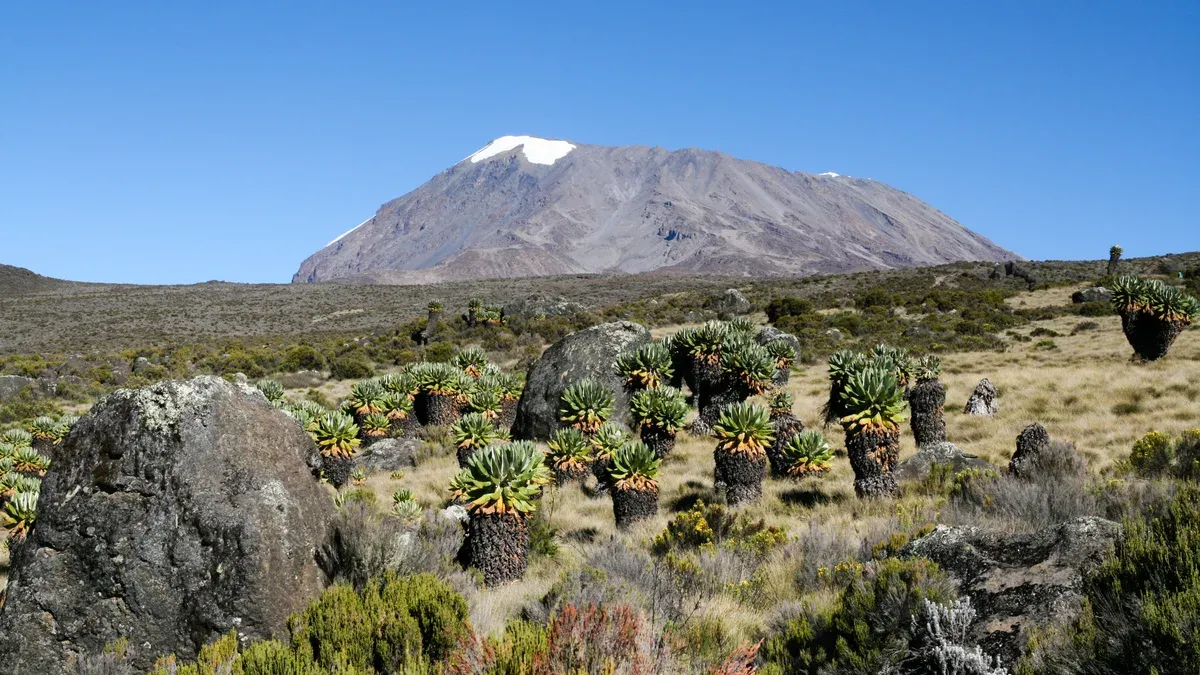
Giant groundsels below Kibo. Photo: Christoph Strässler from Oberdorf BL, Schweiz, CC BY-SA 2.0, via Wikimedia Commons
Quick answer The park at a glance
Kilimanjaro National Park was established in 1973, covers 1,688 km2 (652 sq mi) and charges a conservation fee of $70 (USD 70) per person per day for adult foreign visitors. UNESCO declared it a World Heritage Site in 1987. Every climb inside the park must follow a designated route with a licensed guide and enter through an authorised gate.
Key takeaways
- See how the routes compare on the comparison table and the guide to Lemosho, Machame and the Northern Circuit.
- The TANAPA fee lines and which tours include them are set out in the park fees and rules section below.
- Gates, altitudes and one-day entry options are covered under the gates and day visits.
- For the mountain itself, start with Kilimanjaro climbing tours.
The Park in Figures
The core numbers behind Kilimanjaro National Park, with the source named for each figure.
Founded, Listed and Measured
Kilimanjaro National Park was established in 1973 and covers 1,688 km2 (652 sq mi). UNESCO inscribed it as a World Heritage Site in 1987 under criterion vii, reference number 403. The park is run by the Tanzania National Parks Authority and lies about 300 km south of the equator at 3°04'S 37°22'E. Its headquarters sit at Marangu, about 44 km from Moshi and 86 km from Kilimanjaro International Airport. The highest point inside the park is Uhuru Peak at 5,895 m (19,341 ft), the figure TANAPA and UNESCO use from a 1952 survey, though later measurements gave 5,892 m, 5,902 m and 5,899 m. The park earned about US$51 million in revenue in 2013, which Wikipedia reports as the second highest of any Tanzanian national park that year. It was named one of the Seven Natural Wonders of Africa in 2013.
The mountain itself first drew recorded climbers long before the park existed. Hans Meyer and Ludwig Purtscheller made the first recorded ascent on 6 October 1889. Today about 50,000 trekkers a year attempt the summit, and Wikipedia gives a 70 to 80 percent average success rate. In 2011 to 2012 the park recorded 57,456 tourists, of whom 16,425 hiked the mountain, against a management-plan capacity of 28,470 climbers a year.
| Fact | Figure | Source |
|---|---|---|
| Year established | 1973 | Wikipedia |
| UNESCO World Heritage listing | 1987, criterion vii, ref 403 | Wikipedia |
| Park area | 1,688 km2 (652 sq mi) | Wikipedia |
| Highest point | Uhuru Peak, 5,895 m (19,341 ft) | TANAPA and UNESCO via Wikipedia |
| Visitors in 2011 to 2012 | 57,456, of whom 16,425 hiked | Wikipedia |
The Forest Reserve and the Boundary
Before it was a national park, the mountain was protected as a reserve. The German colonial government made Kilimanjaro a game reserve, and in 1921 it was designated a forest reserve. The forests on the mountain cover about 1,000 km2.
In 2005 the park was enlarged to take in the whole montane forest that had been the Kilimanjaro Forest Reserve. The lower slopes outside the park are farmed, with coffee growing in the Chagga home gardens between 1,000 and 1,800 m. Rainfall shapes the boundary country too, as the lower southern slope receives 800 to 900 mm a year, rising to 1,500 to 2,000 mm at 1,500 m and over 3,000 mm locally in the forest belt at 2,000 to 2,300 m.
Sources: Wikipedia, Mount Kilimanjaro, UNESCO, Kilimanjaro National Park
Five Climate Zones
A walk up Kilimanjaro crosses five distinct zones in a few days. Wikipedia's altitude bands and the species each zone carries are set out below, so you know what to expect at every camp.
From Farmland to Ice
The lowest band, bushland and lower slopes at 800 to 1,800 m, is Chagga farmland with coffee. The rainforest zone runs from 1,800 to 2,800 m and holds blue monkeys, eastern black and white colobus, bushbabies, Cape buffalo and leopards all live in the montane forest. Above that, the heather and moorland zone stretches from 2,800 to 4,000 m, with the Erica heathland band at 3,100 to 3,900 m. The alpine desert zone runs from 4,000 to 5,000 m and the arctic summit zone from 5,000 m to the top at 5,895 m.
Endemics give the zones their character. The giant groundsel Dendrosenecio kilimanjari is among the endemic species, and the Helichrysum zone reaches 4,500 m. The Kilimanjaro shrew and the chameleon Kinyongia tavetana are also endemic. Above the tree line, bushbuck and red duiker occur in places alongside tree hyrax, grey duiker and rodents. Elephants occur between the Namwai and Tarakia rivers and sometimes at higher elevations, and Wikipedia names elephants and Cape buffaloes as the potentially hazardous animals on the mountain. Zebras, leopards and hyenas have been seen on the Shira plateau. Conditions change as fast as the vegetation, with the summit averaging about -7 °C and the Machame 10 weather station at 5,803 m recording an annual low of -13.4 °C and a high of 6.5 °C over 2012 to 2015.
| Zone | Altitude | What grows or lives there |
|---|---|---|
| Bushland and lower slopes | 800 to 1,800 m | Chagga home gardens with coffee between 1,000 and 1,800 m |
| Rainforest | 1,800 to 2,800 m | Blue monkeys, black-and-white colobus, bushbabies, Cape buffalo, leopards |
| Heather and moorland | 2,800 to 4,000 m | Erica heathland at 3,100 to 3,900 m, Helichrysum to 4,500 m |
| Alpine desert | 4,000 to 5,000 m | Sparse plants, grey duiker and tree hyrax in places, rodents |
| Arctic summit | 5,000 to 5,895 m | Glaciers including Credner, Furtwangler and Rebmann, about -7 °C average |
The Ice Above the Zones
The summit zone is shrinking. Summit ice covered about 20 km2 (7.7 sq mi) in the late 1880s. The Cryosphere study by Cullen and colleagues reports glacier area falling from 11.40 km2 in 1912 to 1.76 km2 in 2011, a loss of about 85 percent.
Wikipedia gives under 1 km2 for June 2011, so the sources differ on the exact remainder. The study projects most of the plateau and southern ice gone by 2040 and none left after 2060, while Alpinist reports a more aggressive 2033 date. The named summit glaciers include Credner, Furtwangler and Rebmann, and the Northern Ice Field was the largest remaining ice body at 0.95 km2 in 2007.
Average annual ice loss accelerated from 1.1 percent between 1912 and 1953 to 2.5 percent between 1989 and 2007.
Park Fees and Rules
TANAPA sets every fee climbers pay inside the park. The figures below come from the official tariff booklet covering 1 July 2023 to 30 June, and operator estimates are noted where they differ.
The TANAPA Fee Lines
The tariff booklet titled Tariffs 2023/2026 runs July to June, so its validity ends on 30 June. All charges are VAT (18 percent) exclusive, so treat the lines below as before tax. Fees once paid are non-refundable, and proof of identification is mandatory at the entry gate. Payments go through the government electronic payment gateway via TANAPA online reservation, bank cards and mobile payment.
For an adult non-East African visitor aged 16 and over, the conservation fee is US$70 per person per day. Ages 5 to 15 pay US$20 per day, under 5 is free, expatriates and Tanzania residents pay US$35 and East African citizens pay TZS 10,000. Camping in the public campsites costs US$50 per person per night for ages 16 and over and US$10 for ages 5 to 15. The hut fee on the Marangu route is US$60 per person per night for adults and US$20 for children, covering Mandara, Horombo and Kibo huts. Sleeping at Upper Barafu Camp costs US$100 per night for adults and US$20 for children, a line that operators call Kosovo high camp or crater camping. The rescue fee is US$20 per person per trip and is non-refundable. The crew fee for Tanzanians is TZS 5,000 per trip, paid by the operator, which Altezza Travel puts at about US$2, while Footslopes Tours estimates US$2 to US$10 per crew member per day, so the two disagree.
A worked example from the TANAPA booklet: a seven-day Lemosho climb for one adult comes to 7 conservation days at US$70, 6 camping nights at US$50 and a US$20 rescue fee, which is US$810 before VAT. Altezza Travel quotes the same US$810 base and gives a worked example of US$1,708 for two foreigners, or US$2,015 with VAT, while climbing-kilimanjaro.com gives US$820 before VAT and US$967.60 after VAT for the same climb. Footslopes Tours estimates total park fees for a typical climb at US$800 to US$1,500 per person depending on days and route. Altezza Travel also lists a forest fee of US$10 per adult charged once per tour, but the TANAPA tariff lines read list no forest fee, so its official status is not confirmed. Beyond climbing, the tariff lists Mawenzi Peak technical climbing at US$750 per person per day, cycling at US$50 per person per day on top of the conservation fee, and paragliding at US$500 for a pilot and US$250 for a passenger per day.
| Fee line | Adults 16+ | Ages 5 to 15 |
|---|---|---|
| Conservation fee, per day | US$70 | US$20, free under 5 |
| Public campsite, per night | US$50 | US$10 |
| Mandara, Horombo and Kibo huts, per night | US$60 | US$20 |
| Upper Barafu Camp, per night | US$100 | US$20 |
| Rescue fee, per trip | US$20, non-refundable | US$20, non-refundable |
| Crew fee, per trip | TZS 5,000, paid by the operator | same |
The Rules Inside the Park
Two rules shape every visit. Climbs inside the park must follow designated routes with a licensed guide, and entry is only through authorised gates. Wikipedia gives the minimum permit age as 10 years, though it notes a 7-year-old, Keats Boyd, summited on 21 January 2008, and Altezza Travel says children under 10 may not ascend above 3,700 m, so check the age conditions of your specific permit. Fees are charged per day inside the park, and operators count the days differently: Altezza Travel charges park days per route as Lemosho 6 to 8, Machame 6 or 7, Marangu 5 or 6, Rongai 6 or 7, Umbwe 6 or 7 and Northern Circuit 10.
Most multi-day tours fold these fees into the price, but not all, so read the inclusions. Lemosho Route 7 Days by Altezza Travel at $3,959 per person includes all fees collected by Kilimanjaro National Park. The budget Marangu Route 5 Days Budget at $1,350 includes park fees and permits and national park rescue fees, though a hotel night in Moshi is not included. The Umbwe Route 6 Days at $2,242 includes all park fees, government tax and park rescue fees. The ZAFS 7-day Machame listing does not say whether park fees are in the price, so ask before booking. For how fees fit into a total budget, see the comparison table on the homepage.
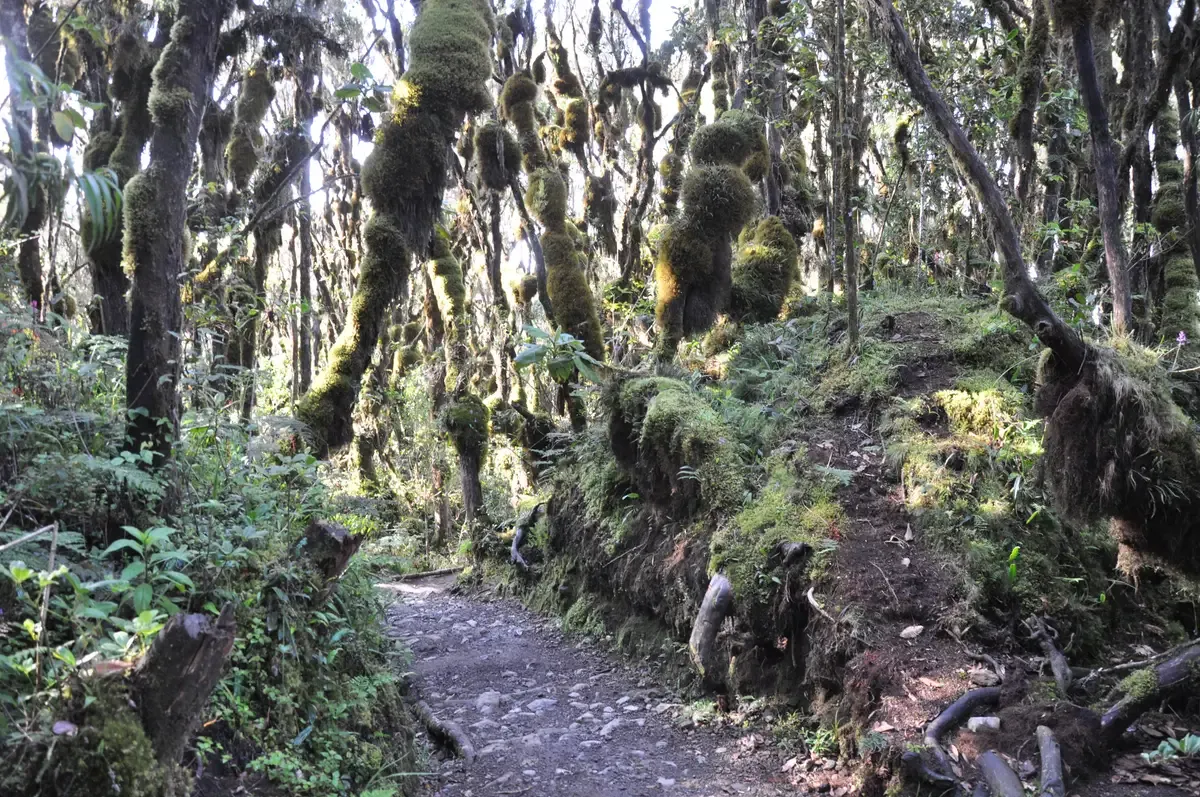
The montane forest trail. Photo: Jorge Láscar from Australia, CC BY 2.0, via Wikimedia Commons
The Gates and Day Visits
Seven gates handle registration for the routes. Altitudes below come from Footslopes Tours, the fullest gate table found, and one itinerary contradicts the Marangu figure.
Where the Routes Start and Finish
Marangu Gate is the park headquarters and the most developed gate, listed by Footslopes Tours at 1,860 m, though one itinerary gives the Marangu start as 1,905 m, and operator figures for the same gate range from 1,800 m to 1,860 m. Footslopes gives Machame Gate as 1,800 m, Umbwe Gate as 1,600 m and Rongai Gate as 1,950 m. Londorossi Gate, at 2,250 m per Footslopes and 2,100 to 2,200 m per other operators, handles the Lemosho, Shira and Northern Circuit entries, and it and Rongai are 3 to 4 hours from Moshi.
Shira Gate is the highest entrance at 3,600 m per Footslopes, with operator figures from about 3,400 m. Mweka Gate at 1,640 m is exit only. From the park headquarters at Marangu you are about 44 km from Moshi and 86 km from Kilimanjaro International Airport.
| Gate | Altitude per Footslopes Tours | Use |
|---|---|---|
| Marangu Gate | 1,860 m | Headquarters, Marangu route start |
| Machame Gate | 1,800 m | Machame route start |
| Umbwe Gate | 1,600 m | Umbwe route start |
| Rongai Gate | 1,950 m | Rongai route start |
| Londorossi Gate | 2,250 m | Lemosho, Shira and Northern Circuit entry |
| Shira Gate | 3,600 m | Highest gate |
| Mweka Gate | 1,640 m | Exit only |
Day Visits Without a Summit Bid
You do not need a multi-day permit to set foot in the park. Two bookable day hikes run from Moshi onto the Marangu route. The Kilimanjaro Day Hike by Kilinge Adventures costs $100 per person for a 10-hour private hike from Marangu Gate at 1,800 m to Mandara Hut at 2,743 m, a gain of 915 m, with a guide, lunch and bottled water.
Its listing states the park entry fee is not included, so budget for it separately. The Kilimanjaro Day Trek by Pale Tours Tanzania costs $86 per person for about 12 hours with a choice of the Marangu, Machame or Lemosho gate. Its park fee is USD 85 per person, paid by card at the gate, and one reviewer reports being asked to pay it again for a stay in the park after 5:00 PM.
Kilita Safaris sells a similar one-day Marangu hike reaching Mandara Hut at 2,720 m and continuing to Maundi Crater from US$100, with free pickup from any Moshi hotel. If three days suits you better, the Kilimanjaro 3-Day Trek to Horombo Hut at $850 climbs to Horombo Hut at 3,720 m and does not attempt the summit. See the one-day hikes compared under the routes section of the homepage.
Do and Don't at the Park
Five things to do and four to avoid, each grounded in the park's own figures and rules.
Do
- Do carry identification to the gate, because the TANAPA tariff states proof of identification is mandatory at entry.
- Do budget 18 percent VAT on top of every fee line, because the tariff booklet states all charges are VAT exclusive.
- Do check that your tour price names park fees before booking, because listings differ and the ZAFS Machame 7-day listing does not state it.
- Do bring a card rather than relying on cash, because payments go through the government electronic payment gateway via TANAPA online reservation, bank cards and mobile payment.
- Do keep distance from elephants and Cape buffalo, because Wikipedia names them as the potentially hazardous animals on the mountain.
Don't
- Don't assume your fee is refundable if plans change, because the tariff states fees once paid are non-refundable.
- Don't try to enter without a licensed guide or off the designated routes, because park rules require both.
- Don't plan a full climb for a child under 10 without checking conditions, because Wikipedia gives the minimum permit age as 10 and Altezza Travel says under-10s may not ascend above 3,700 m.
- Don't treat the tariff as fixed, because the booklet used here has a stated end date and fees can change.
Kilimanjaro National Park FAQ
How much does it cost to enter Kilimanjaro National Park?
The conservation fee under the TANAPA tariff for 1 July 2023 to 30 June is US$70 per person per day for adults aged 16 and over, US$20 for ages 5 to 15 and free under 5, all before 18 percent VAT. Climbers pay it for every day inside the park. See the fee table in the park fees section.
When was Kilimanjaro National Park created and when did UNESCO list it?
The park was established in 1973 and UNESCO declared it a World Heritage Site in 1987 under criterion vii, reference number 403. It had earlier protection as a forest reserve from 1921. The founding details are in the park in figures.
Where do you sleep when you climb inside the park?
On camping routes you sleep in tents at public campsites at US$50 per person per night, and on the Marangu route in huts at Mandara, Horombo and Kibo for US$60 per night. A night at Upper Barafu Camp costs US$100. Most tours include these fees, such as Marangu Route 5 Days at $2,402.60, which includes national park fees, hut and camping fees and rescue fees.
Do I have to climb to the summit to visit the park?
No. Day hikes can enter at Marangu Gate and turn back at Mandara Hut at 2,743 m or Maundi Crater. The Kilimanjaro Day Hike costs $100 per person for 10 hours, though its park entry fee is not included, and the Kilimanjaro Day Trek at $86 has a USD 85 park fee paid at the gate.
How hard is it to climb Kilimanjaro in the park's terms?
About 50,000 trekkers a year attempt the summit and Wikipedia gives a 70 to 80 percent average success rate, though operator claims differ. The minimum permit age is 10 years per Wikipedia. Route difficulty and itineraries are compared on the comparison table of Kilimanjaro tours.
How many climbers die in Kilimanjaro National Park?
No official count exists. MountainIQ estimates 3 to 10 deaths per year including porters, while a Kilimanjaro Christian Medical Centre study cited by Wikipedia found 25 deaths in about 8 years. For more acclimatisation, choose an itinerary such as Lemosho Route 8 Days at $3,200, which adds an extra acclimatisation day.